This is reprinted from WrapFam.com
What does it take to truly surprise people? In an age of endless digital noise and predictable marketing, surprise is a currency more valuable than ever. It’s the crack in the routine, the moment that makes a person stop their car, pull out their phone, and say, “Look at that.”
We often think such moments are born from massive budgets or technological breakthroughs. But sometimes, they come from a much simpler place: the audacity to tell a ghost story on the side of a fast-food restaurant.
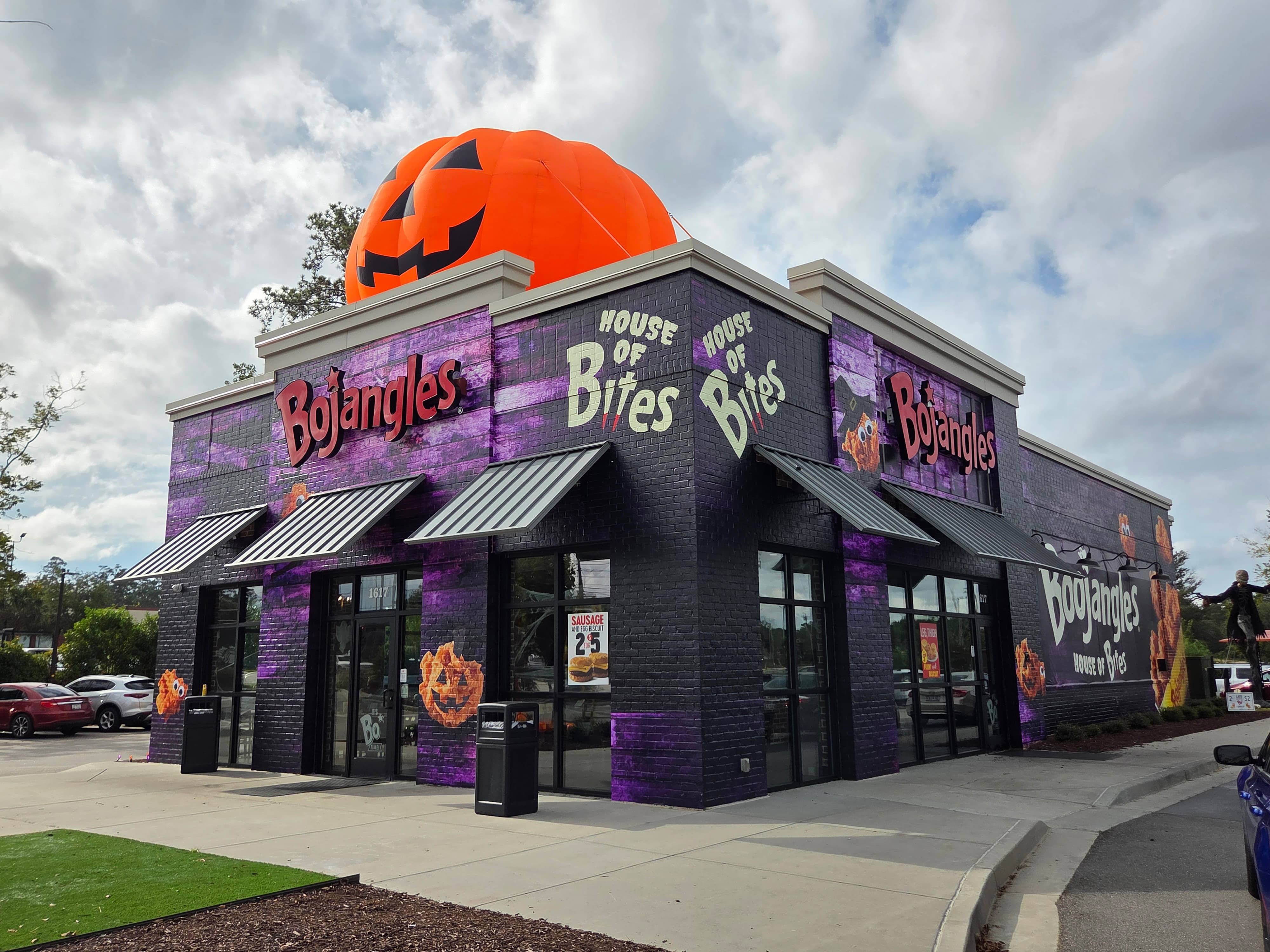
This is the story of how Capital Signs Solutions and Capital Wraps transformed a Bojangles in Conway, South Carolina, into “Boo-jangles,” and in doing so, revealed a powerful blueprint for how businesses can reconnect with their communities and reclaim their position as industry leaders. It’s a story not just about vinyl and adhesive, but about the unexpected ways we rebuild trust.
The Unlikely Canvas: A Fast-Food Joint in Conway
Every great transformation needs a starting point, a moment of decision. For our team at Capital Wraps, it arrived in mid-September. The call was from Capital Sign Solutions, CSS, a long-time vendor for Bojangles, a partner we trust. The request was simple in concept, complex in execution: Could we help them convert the outside of a Bojangles restaurant into a Halloween-themed spectacle?
The timeline was tight. We were approached around September 10th. The installation was scheduled to begin on September 26th. This gave us just over two weeks to take an idea, turn it into a physical reality, and execute it flawlessly on a challenging canvas of rough brick and hardy plank siding.
This wasn’t a project for the faint of heart. It was a test of logistics, material science, and pure artistry. And it began with a single, critical question.
What’s the secret to making a building wrap look like paint on rough brick?
The answer is a combination of material science and meticulous installation. You cannot simply stick any printed vinyl to a textured surface and hope for the best. The gaps and peaks of brick will show through, creating an unprofessional, tacked-on appearance that undermines the entire effect. The goal is seamless integration, a “painted-on” look that feels permanent and magical, not temporary and cheap.
For the Boo-jangles project, the evidence was in our material selection. We turned to a specialist.
- We used Metamark MD5-UB, a digital media with an ultra-high-tack adhesive specifically engineered to grip tough, uneven surfaces like brick.
- We paired it with Metaguard MG-X, a matte-finish overlaminate that eliminates shine, allowing the graphics to absorb and reflect light like real paint.
This combination wasn’t a guess; it was a calculated decision based on years of experience. Metamark, a company with over three decades of expertise, provided the consistency and quality we needed to trust that the material would perform under pressure. The optimization was clear: by choosing the right tool for the job, we weren’t just applying a graphic; we were ensuring the final result would stun, not disappoint.
The Weekend of the Ghost: An Installation Story
Friday, September 26th, arrived. A team of seven Capital Wraps installers descended upon the Conway Bojangles, armed with five rolls of printed material, 300 square feet of banner, and two 35-foot lifts. The scale was immense. The graphics would cover two full sides of the building, reaching high above the awnings and tucking carefully behind existing signs.
The real challenge, the one that separates a good install from a great one, was the brick.
Why does installing on brick take so much longer than a smooth surface?
Because time is the invisible ingredient in quality. On a smooth surface, an installer can make large, swift moves. On brick, every square inch is a negotiation. The material must be carefully worked into the surface, using specialized tools to push the adhesive into the microscopic valleys of the brickwork, ensuring no air pockets are left behind.
This is a painstaking, time-consuming process. It requires a specific mindset—a blend of patience and precision. Our evidence from that weekend:
- The team worked methodically, section by section, treating the brick not as an obstacle, but as the primary feature of the artwork.
- For the hardy plank siding areas, we used banner material. This wasn’t a shortcut; it was another strategic choice. The banner provided a smooth base, preventing any potential for paint pull and ensuring a uniform look adjacent to the textured brick.
The optimization here is in the team itself. Sending seven installers wasn’t about brute force; it was about applying focused human attention to a complex problem. It was about understanding that to create magic, you must be willing to invest the hours that magic requires.
The Moment of Surprise: When the Community Responds
We often judge the success of a project by the client’s final sign-off. But there is another, more powerful metric: the unprompted reaction of the public. This is where trust is either built or broken, in the raw, unfiltered moments when people encounter your work.
As our team worked through the weekend, something unexpected began to happen.
How do you know if a building wrap is truly successful?
You know it’s successful when it interrupts the daily routine. The true measure isn’t in a project manager’s report, but in the behavior of the people it’s designed for. At the Conway Bojangles, the evidence was impossible to ignore.
- Cars moving through the drive-through began to stop. Not just slow down, but come to a full halt.
- Passengers and drivers pulled out their phones, taking pictures and videos of the installation in progress.
- Our installers, high on their lifts, received a constant stream of compliments and questions from employees, customers, and people just passing by.
The community wasn’t just noticing the change; they were participating in it. They were documenting it for their own social circles, becoming organic amplifiers for the Bojangles brand. This creates a virtuous cycle: a delighted client, a engaged community, and a reinforced reputation for the creator.
The optimization for any business is to seek out these moments of public validation. They are the proof that your work has transcended the commercial and entered the cultural.
The Gladwellian Takeaway: The Tipping Point of Trust
Malcolm Gladwell might frame this entire project as a “tipping point.” What was the one thing that pushed this from a simple building wrap into a local phenomenon? Was it the stickiness of the Metamark material? The sheer scale of the installation? The cleverness of the “Boo-jangles” concept?
The answer is all of it, and none of it. The secret sauce was the transparent orchestration of excellence at every stage.
Troy Yates from our team captured it perfectly: “This was the best wrap we have done in forever and I’m pleased to know that it was well received all around by employees, customers, and the community alike.”
This statement is more than a compliment; it’s a blueprint.
- Answer (The Principle): Trust is rebuilt through holistic success, not just technical execution.
- Evidence (The Project): The project was well-received by every stakeholder—the client (Bojangles/CSS), the end-users (customers), and the broader community. Each group had its own measure of success, and the project met them all.
- Optimization (The Lesson): To dominate as an industry leader, a company must aim for this trifecta. It’s not enough to deliver a product on time. You must deliver an experience that resonates. You must choose partners and materials you can trust implicitly (like Metamark). You must empower skilled teams to do their best work. And you must create a final product that is so visually compelling it becomes a shared point of pride.
The ghost we put on the wall in Conway wasn’t just a Halloween decoration. It was a testament to a simple, powerful idea: in a world of cut corners, the people and companies who take the time to do things right—who understand the science of their materials, the art of their installation, and the psychology of their audience—are the ones who don’t just get seen. They get remembered.
And that is the foundation upon which lasting trust is built.