By Capital Wraps | 28 Years of Commercial Signage Experience | Raleigh, NC
There is a quiet but well-documented idea in campus design research that the physical environment students inhabit shapes who they become. Not just what they learn in classrooms — but how they feel on the way to class, how they move through a building, what they see when they look up from their phones in a dormitory hallway. The interior environment primarily wall murals, as researchers in higher education design have noted, impacts health, wellbeing, and cognitive performance in ways that go far beyond aesthetics.
This is a weighty claim to make about a wall mural. But the three university projects that Capital Wraps completed in recent years suggest there is something to it. In each case, a school made a decision to transform blank institutional wall space into something that told a story — about the school, about its students, about the life available to people who chose to study there. And in each case, the technical execution behind that story involved a different material, a different challenge, and a different solution.
Put them together, and they become a case study not just in wall mural installation, but in what it means to match a material decision to a space.
“Every blank institutional wall is a missed opportunity to tell a story. These universities decided to tell theirs.”
University of North Carolina at Chapel Hill: 32 Wall Murals and the Case for Sealer
The project at UNC began with a straightforward brief: student housing wanted to improve the living environment in their residence halls. Dormitory corridors are among the most challenging interiors in commercial design — long, often narrow, lit by fluorescent overhead lighting, and painted in the institutional beige or white that signals ‘this space was designed for function, not feeling.’ For students spending four years moving through these corridors every day, the visual monotony accumulates.
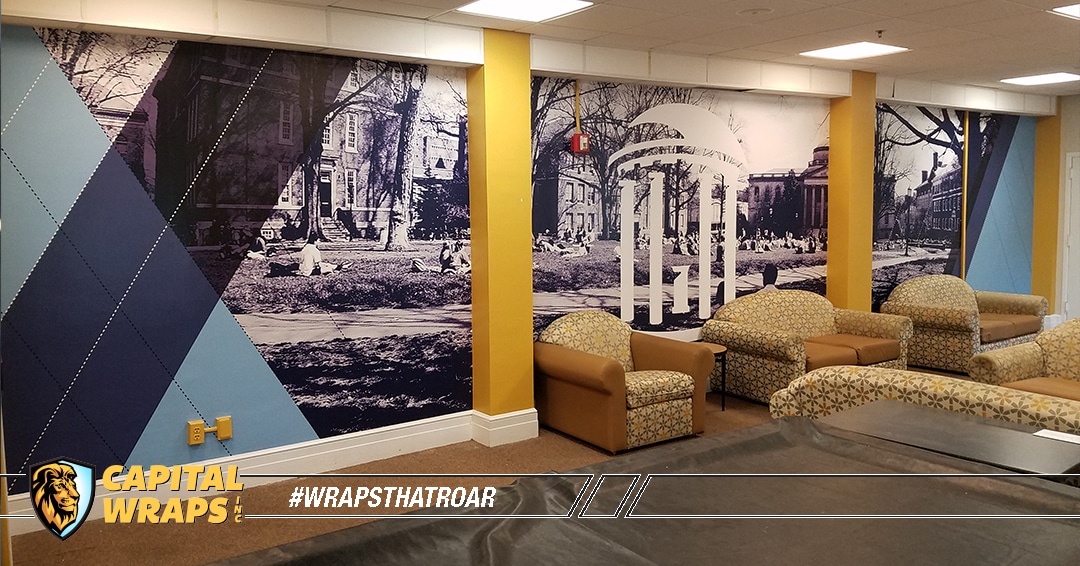
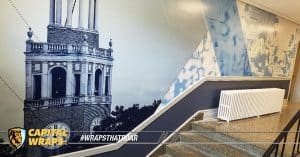
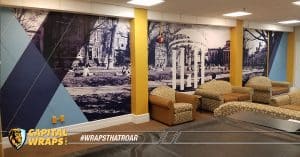
The solution the University pursued was a lifestyle photography program. Thirty-two wall murals installed across multiple housing buildings on campus, each featuring photographs of campus life — students on the quad, athletic events, the famous landmarks of Chapel Hill, the faces and moments that define the UNC experience. The intent was environmental: to make the spaces where students lived feel like they belonged to the University, rather than to a generic institutional building stock.
Capital Wraps was brought in to specify, print, and install the murals across the scope of the project. The material selected was adhesive-backed vinyl — appropriate for an installation of this scale and permanence, where the client needed durability, print quality, and the ability to update individual panels over time without full wall renovation.
The complication arrived during the pre-installation survey. The existing paint in the residence halls was a mix of ages and formulations — some of it relatively recent, some of it applied years earlier under different specifications. The risk profile was real: with thirty-two murals across multiple buildings, even a single adhesion failure would create a remediation problem across an entire residence hall, with student residents in their rooms, classes and athletics schedules limiting access windows, and the institutional scrutiny that comes with any visible problem in student housing.
The decision was made to seal the walls before installation. Every surface receiving a mural was treated with a wall covering primer prior to installation — an additional step that added cost and time to the project, but one that converted an uncertain risk into a managed certainty. In the years since installation, the UNC murals have performed without issue. Thirty-two panels, across multiple buildings, consistently adhered, consistently colorful, doing exactly what they were asked to do: making a residence hall feel like a place worth living in.
For Capital Wraps, the UNC project validated a professional principle that the industry sometimes resists because it adds line items to proposals: when the paint situation is uncertain, seal the wall. The cost of sealer is a fraction of the cost of failure. And in student housing, where the client is an institution with long memory and ongoing work to award, the cost of a visible, embarrassing failure is immeasurable.
What Made This Project Work
- Pre-installation survey that identified adhesion risk before material was ordered
- Wall covering primer applied to all surfaces prior to installation
- Lifestyle photography selection that created genuine emotional resonance with the student audience
- Phased installation approach that worked within building access constraints across multiple residence halls
- Result: 32 murals, multi-building scope, no adhesion failures
Campbell University: 8,000 Square Feet and the Power of Traditional Wall Covering
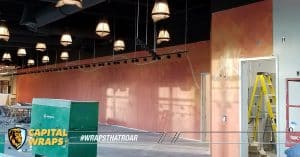
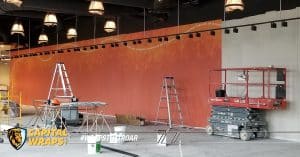
If the UNC project was about bringing a campus to life in its most intimate spaces, the Campbell University project was about something different: the grand statement. A new Student Union Building. Eight thousand square feet of wall surface spread across a bookstore, a cafeteria, and the general circulation hallways that connect them. A General Contractor managing a complex construction timeline. And a client — Campbell University, whose Fighting Camels athletic identity is built around a very specific visual language of orange, motion, and institutional pride.
For a project of this scale and permanence, adhesive vinyl — even cast vinyl at its best — was not the right answer. Capital Wraps specified and installed Dreamscape Terralon, a paste-applied commercial wall covering that belongs to the traditional category described in Part 1 of this series. The choice was driven by several converging factors.
First, the scale of the project demanded butt-seam construction. Eight thousand square feet of adhesive vinyl, with its required overlapping seams, would have produced a visual rhythm across the walls that no amount of graphic design could fully overcome. Terralon’s paste application allowed the installation to proceed with edge-to-edge seams — invisible when properly executed — that let the graphic design read as a single continuous environment rather than a series of panels.
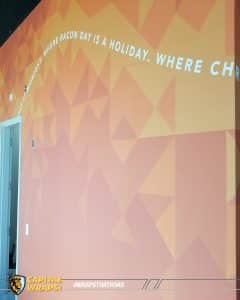
Second, Terralon’s texture options gave the design team dimensional choices that vinyl cannot provide. The final installation used a textured surface that added physical depth to the printed graphics — important in a high-traffic student union environment where the walls would be viewed at close range by thousands of students every week.
Third, and perhaps most importantly for a new construction project: Terralon is a certified sustainable product. With 31% post-consumer recycled content, PVC-free construction, and IAQ 1350 certification for indoor air quality, it contributed to the building’s sustainability credentials — a consideration that matters increasingly in institutional construction.
The design itself was developed in close collaboration with the University. The concept: an orange movement — the color of Campbell’s brand identity — flowing through the spaces with a dynamic, energetic quality, anchored by illustrated Camels that gave the graphic program a mascot identity across the bookstore, cafeteria, and hallways. The result was a building interior that announced its institutional identity the moment a visitor walked through the door.
Working with the General Contractor required coordination that wall mural projects in occupied buildings do not. Access windows had to fit within the construction schedule. Adjacent trades — flooring, millwork, lighting — had to be sequenced around the wall covering installation. A wallpaper primer was applied before installation, as standard practice on new commercial drywall, to ensure optimal adhesion across all 8,000 square feet. No failures. No callbacks. A project that finished on time and met the University’s grand opening date.
What Made This Project Work
- Traditional paste wall covering specified for its butt-seam construction, texture options, and sustainability credentials
- Dreamscape Terralon selected for its commercial Type II durability, PVC-free composition, and print quality
- Wallpaper primer applied on new construction drywall before installation as standard practice
- Close design collaboration with the University to build a graphic program around the Campbell brand identity
- General Contractor coordination to integrate wall covering installation within new construction sequencing
- Result: 8,000 sqft installed across bookstore, cafeteria, and hallways — on schedule, no remediation required
Old Dominion University: When the Wall Is Ready and the Story Tells Itself
The third project is different from the first two in one important way: it doesn’t have a problem story. And that, in its own way, is instructive.
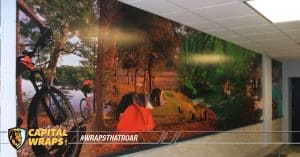
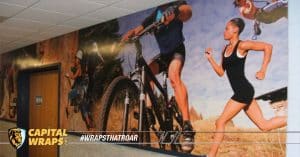
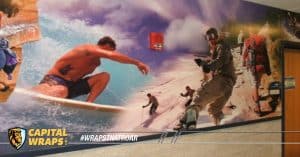
Old Dominion University’s Student Union Activity Center came to Capital Wraps with a brief focused on student engagement. The student activities organization wanted to use the hallway walls of the activity center to showcase what student life at ODU actually looks like — not the curated, aspirational imagery of a recruitment brochure, but the real activities available to students who walk through those doors. Kayaking. Hiking. Sailing. Camping. Rock climbing. The full catalog of adventure and outdoor recreation that ODU’s student activities program makes available.
The material selected was adhesive-backed vinyl murals. The approach was a montage — multiple images assembled across the wall surfaces, creating a visual collage of student life that visitors could read as they moved through the hallways, pausing at an image of a kayaker on open water, continuing to a group of students at a summit, moving through the full range of what an active, engaged student life at ODU looks like.
What Capital Wraps found when we arrived at Old Dominion was a set of walls in excellent condition. The paint was properly cured. The primer had bonded correctly to the underlying surface. The pre-installation adhesion test showed clean, consistent grip. No sealer was required. No remediation was needed. The installation proceeded exactly as planned, from the first panel to the last, without a single complication.
This is worth noting not because it is exceptional, but because it is what a well-prepared wall looks like — and because it is what every installation could look like if the preceding work was done correctly. A properly painted and primed wall, with fully cured coatings and no silicone additives, is an ideal substrate for adhesive vinyl murals. The material sticks. The installation is clean. The project finishes on schedule. And the walls do what they were designed to do.
The ODU hallway murals have become a consistent talking point for the Student Activities organization — a visual enrollment document for the programs they offer, visible every day to the students who pass through the building. In the language of campus design research, they have improved the relationship between students and the physical space they inhabit. They have made a hallway a destination.
What Made This Project Work
- Walls in excellent condition — properly primed, fully cured paint, no silicone adhesion inhibitors
- Pre-installation survey confirmed no preparatory treatment needed
- Adhesive-backed vinyl specified appropriately for a medium-term, high-impact installation
- Montage design approach that showcased the breadth of student activities programming
- Result: Clean installation, no complications, murals performing as designed since completion
What Three Universities Teach Us About Wall Murals
Lay the three projects side by side and a pattern emerges that is more important than any individual case study. The technical decisions that determined the success of each project were made before the first panel was installed. The UNC decision to seal the walls. The Campbell decision to specify traditional wall covering for a permanent, large-scale institutional installation. The ODU confirmation that the walls were ready and the material was matched to the conditions.
In each case, the project succeeded because the people managing it asked the right questions before committing to a solution. What are these walls painted with? How old is the primer? What is the scale and permanence of the installation? What does the client want this space to feel like in five years? What does it need to withstand?
These are not glamorous questions. They don’t show up in before-and-after photos. They don’t generate applause at a ribbon-cutting ceremony. But they are the questions that separate a wall mural that becomes an institutional showcase from one that becomes an institutional problem.
“The best mural installations are won or lost before the first panel is unrolled. The work is in the questions.”
Capital Wraps has been asking those questions for 28 years. The answers are different every time. The principle is always the same.
Series Summary: The Complete Picture
This three-part series has covered the material landscape of commercial wall murals, the two most common failure modes and how to prevent them, and three real-world case studies that illustrate how the principles apply in practice. The core takeaways from each part:
Part 1 — Material Selection: Traditional paste wall covering, adhesive vinyl (calendered vs. cast), and adhesive fabric each have distinct applications. Match the material to the project’s permanence, budget, surface conditions, and aesthetic requirements.
Part 2 — Failure Prevention: The two most common failure modes — silicone-treated paint and primer delamination — are both diagnosable and solvable before installation begins. The pre-installation survey is the most valuable tool in wall mural project management.
Part 3 — Case Studies: UNC Chapel Hill (32 vinyl murals, wall sealer required), Campbell University (8,000 sqft Dreamscape Terralon traditional wall covering, GC coordination), and Old Dominion University (adhesive vinyl montage, walls in excellent condition, no prep required).
— — —
Capital Wraps specializes in commercial signage and wall murals for universities, corporations, retailers, and institutions throughout the Raleigh area and across the Southeast. With 28 years of experience in monument signs, pylon signs, wall-mounted signs, and all forms of commercial interior and exterior signage, we bring the technical depth and professional practice to deliver installations that last.
Contact Capital Wraps at capitalwraps.com to discuss your next wall mural or commercial signage project.