The Commercial Fleet Wrap Program Playbook: How Service Companies Turn Vehicles Into Marketing Infrastructure
The HVAC company had eleven trucks. They were three different makes, two different colors, and none of them had anything in common except the magnetic door signs that blew off every time a technician got on the interstate.
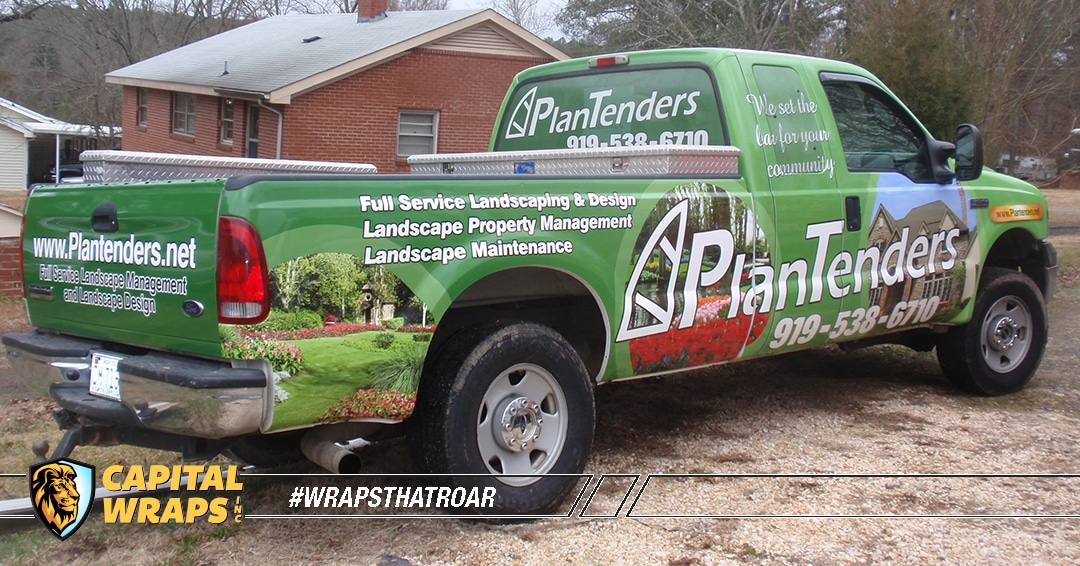
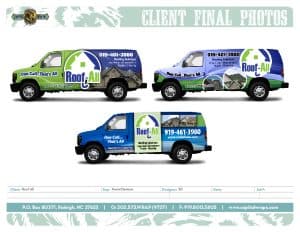
That company called us. Six weeks later, eleven vehicles came out of our facility with the same deep blue matte wrap, the same logo at the same scale, the same phone number in the same white Helvetica at the same height on every door. The owner sent us a message two months after installation. “We got a call last week,” he wrote, “from someone who said they’d been seeing our trucks all over the county and finally decided to call. They became our biggest maintenance contract.”
A professionally wrapped commercial fleet doesn’t just advertise. It creates the perception of market dominance — and perception, in service industries, drives inbound calls.
What a Commercial Vehicle Wrap Actually Is (And Isn’t)
Before we go further, let’s be specific about what we’re talking about.
A commercial vehicle wrap is not a paint job. It’s not a sticker applied at a print shop. It’s not what you see on someone’s personal car at a car show.
A commercial fleet wrap is a precisely printed, high-resolution graphic system applied in premium 3M cast vinyl to your vehicle’s surface — designed to your brand standards, produced at up to 1200×1200 DPI for color accuracy, and installed by PDAA Master Certified technicians who treat the vehicle the way a surgeon treats a patient: no shortcuts, no improvisation, no mystery.
The result is a vehicle that becomes a moving billboard with measurable business impact.
The ROI Math That Fleet Managers Actually Need
A billboard in a major metro area costs approximately $3,000 to $10,000 per month for a single static placement. That’s a recurring expense that ends the moment the contract does.
A full commercial vehicle wrap costs a fraction of that — once. Applied to a vehicle in daily service in a market like Raleigh, Charlotte, Richmond, or the DC metro, a wrapped van or truck generates an estimated 30,000 to 70,000 daily impressions as it moves through traffic, parks in driveways, sits in front of job sites, and backs into loading docks.
Run the math over a five-year material lifespan:
- Cost of the wrap: Executed once, amortized over five years
- Daily impressions: Conservatively 30,000 per day, 250 operating days per year
- Total impressions over five years:5 million on a single vehicle
No other marketing channel your service company runs — not Facebook ads, not direct mail, not radio — delivers that cost-per-impression at that volume. Not even close.
This is why companies like Pepsi, franchise HVAC networks, national pharmacy chains, and regional broadcasting companies invest in fleet wrap programs. It’s not aesthetics. It’s arithmetic.
Full Wrap vs. Partial Wrap vs. Lettering: Choosing the Right Coverage
Not every vehicle needs a full wrap, and not every budget calls for one. Understanding the coverage spectrum helps fleet managers allocate effectively.
Full Wrap
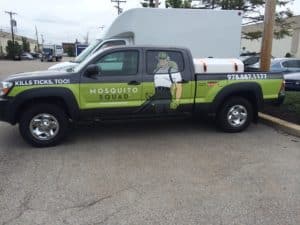
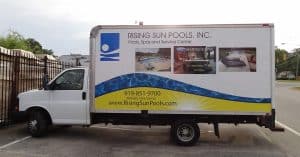
A full commercial wrap covers all exterior surfaces of the vehicle — doors, panels, hood, roof, and rear — with continuous printed graphics. This is the correct solution when:
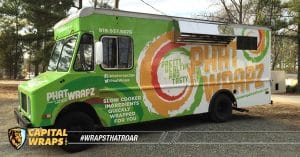
- Brand color is distinctive and differentiation matters (the vehicle itself becomes the brand color, not just a white truck with a logo)
- The vehicle is large and high-visibility (cargo vans, box trucks, sprinters, service trailers)
- The client is building a fleet identity from scratch and wants maximum visual impact
Full wraps on commercial vehicles are executed in 3M cast vinyl with full 3M Performance Warranty coverage.
Partial Wrap (3/4 Wrap)
A partial or three-quarter wrap covers the rear and sides of the vehicle while leaving the cab and hood in the vehicle’s factory paint or a simple vinyl color. This is frequently the most cost-effective choice for:
- Mid-size fleets where budget must be distributed across multiple vehicles
- Companies with multiple vehicle makes and models that need brand consistency
- Service companies adding vehicles to an existing fleet program
A well-designed partial wrap can deliver 80% of the visual impact of a full wrap at a substantially lower per-vehicle cost. The key is design: the graphics have to be engineered to work with, not against, the unpainted portions of the vehicle.
Decals and Lettering
Vehicle lettering — company name, phone number, logo, DOT numbers — is the baseline commercial vehicle graphic solution. For companies that need brand presence on a constrained budget, high-quality cut vinyl lettering on a color-appropriate vehicle is a credible starting point.
The important word is quality. Cut vinyl lettering done with inferior material on a dirty surface, with poor font selection and low-resolution logo reproduction, communicates the wrong thing about your business. Done correctly — with properly prepared surfaces, premium vinyl, and professional design — it communicates what it should: a real company that takes its brand seriously.
How Fleet Size Changes the Conversation
The wrapping strategy for a three-truck plumbing company and a 200-vehicle national franchise system share the same core principles — but the execution differs in ways that matter.
1–5 Vehicles: The Credibility Investment
For small service companies, a professional vehicle wrap is often the most powerful marketing investment they make. A well-wrapped truck in front of a house tells every neighbor on the block that a professional was there. It generates impressions in every neighborhood the technician drives through. It creates the visual parity that makes a one-truck operation look like an established company.
The design brief for small fleet wraps: clean, legible, color-forward. A phone number at the right scale, a logo with enough breathing room to read from 30 feet away, and a brand color system that stands out from the white-truck default of most service companies.
5–50 Vehicles: The Brand Consistency Challenge
Mid-size fleets introduce the problem that keeps marketing directors up at night: consistency. When vehicle #1 came off the lot in 2019 and vehicle #23 was just added from a different manufacturer in a slightly different white, and vehicle #11 had its rear panel replaced after a fender-bender — how do you keep the brand looking like one company?
The answer is a fleet wrap program with a single vendor, a documented design standard, and a production process that manages color accuracy across every print run. At Capital Wraps, we maintain color profiles for clients with ongoing fleet programs, so a vehicle added two years after the initial project matches the fleet it joins.
50+ Vehicles: The National Account Model
Large-scale fleet programs require a different kind of partner. The questions shift from “how does it look” to “how do we execute across multiple locations with zero-downtime installation scheduling, brand compliance documentation, and a single point of contact who understands our procurement process?”
This is what Capital Wraps’ national accounts program is built for. We’ve executed fleet programs for franchise systems, government agencies, and service companies with vehicles across the Eastern United States. The capability isn’t theoretical — it’s documented in 30,000 completed projects.
The Installation Process: What Happens to Your Vehicle
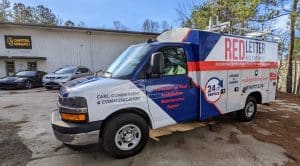
Fleet managers occasionally express concern about the installation process. The concern is understandable — vehicles are operational assets, and any process that takes them offline is a cost center. Here’s exactly what happens, and why the process is worth the time.
Decontamination comes first. Every vehicle is hand-washed and treated with isopropyl alcohol to remove wax, oil, and road contamination. Vinyl adhesion fails on contaminated surfaces. This step is not optional.
Disassembly is the step that separates professional installers from everyone else. Door handles, mirror housings, and trim pieces are removed so the vinyl can wrap behind the edges rather than terminating at them. This is what eliminates the exposed vinyl edge that leads to peeling — and what eliminates the risk of razor blade cuts on your vehicle’s paint, which is the hidden cost of shops that cut around hardware instead of removing it.
Application is where the craft lives. Cast vinyl is applied to the panel using heat guns to conform the film to body contours and squeegees to eliminate air. Complex areas — rivets, body character lines, deep recesses — require skill that only comes from experience. Our senior installers have executed this process across thousands of vehicles on dozens of substrate types.
Post-heating locks the vinyl into its final position. Every inch of applied vinyl is brought to the correct activation temperature to eliminate any residual material tension.
Reassembly and quality inspection complete the process. The vehicle doesn’t leave our facility until it passes our installation standards — which are the PDAA Master Certification standards, not a checklist we invented ourselves.
Protecting Your Wrap Investment: Commercial Fleet Wrap Program: Fleet Maintenance Basics
A commercial vehicle wrap is a durable asset. Treated correctly, it will perform for the full rated lifespan. Treated incorrectly, it won’t.
The four rules every fleet manager should communicate to drivers:
No automatic brush car washes. The rotating bristles of a tunnel car wash will scratch and swirl vinyl surfaces, degrade laminate, and eventually compromise the graphic. Touchless washes are acceptable for most vehicles. Hand washing is always best.
No petroleum-based cleaning products on vinyl. Standard degreasers and some industrial cleaners will degrade vinyl adhesion at edge terminations. Use wrap-safe cleaning products.
No parking under pine trees if it can be avoided. Sap is one of the more aggressive contamination sources for vinyl surfaces, and it becomes significantly harder to remove over time.
Report edge lifting immediately. When a technician notices the vinyl beginning to lift at a door edge or corner, that’s the time to address it — not six months later when the whole panel has delaminated. Small repairs are inexpensive. Replacement panels are not.
Frequently Asked Questions
How long does a commercial vehicle wrap last?
On vertical surfaces (doors, side panels), premium 3M cast vinyl typically lasts 5–7 years under normal conditions. Horizontal surfaces (hoods, roof) see 3–5 years due to direct UV exposure. Real-world lifespan is influenced by parking conditions, washing frequency, and geographic climate. We use 3M Performance Warranty-backed materials on all commercial fleet projects.
How long does installation take, and can it be scheduled around our operations?
A full commercial van or truck wrap typically requires one full day per vehicle. For fleet programs, we work with operations managers to schedule installation in waves that minimize vehicle downtime. We can coordinate installation during off-peak hours, weekends, or in batches designed around your service schedule.
Can you match graphics to vehicles added to the fleet later?
Yes. For clients with ongoing fleet programs, we maintain production files and color profiles so vehicles added months or years later match the existing fleet. Fleet brand consistency over time requires this kind of vendor partnership. It’s one of the reasons we frame our national accounts relationships as programs, not transactions.
What happens to the vehicle paint when the wrap is removed?
When removed within its service life, premium cast vinyl peels cleanly, leaving the original paint undamaged. In fact, the surface under the wrap is typically in better condition than the exposed areas, because the vinyl has been protecting it from UV and road exposure for years. This makes wrapping particularly valuable for fleet vehicles that will be resold or returned at end of lease.
Can you handle a fleet in multiple locations?
Yes. Capital Wraps serves the Southeast and Mid-Atlantic with our own regional team and executes national accounts through a network of certified installation partners and our own traveling installer team. Whether your fleet is concentrated in one market or distributed across ten states, we manage the program as a single point of contact.
A well-executed fleet wrap program doesn’t ask customers to notice your vehicles. It makes not noticing impossible. Consistent brand graphics on every vehicle, in every neighborhood, on every job site — that’s not marketing spend. That’s market presence, built one wrap at a time.
It doesn’t matter if you have one vehicle or 1,000. Capital Wraps executes fleet programs at every scale with the same craftsmanship, the same materials, and the same accountability. Headquartered in Raleigh, NC. Serving the Southeast, Mid-Atlantic, and national accounts nationwide.
Call 877.775.9727 or visit capitalwraps.com.
Wraps that Roar.