
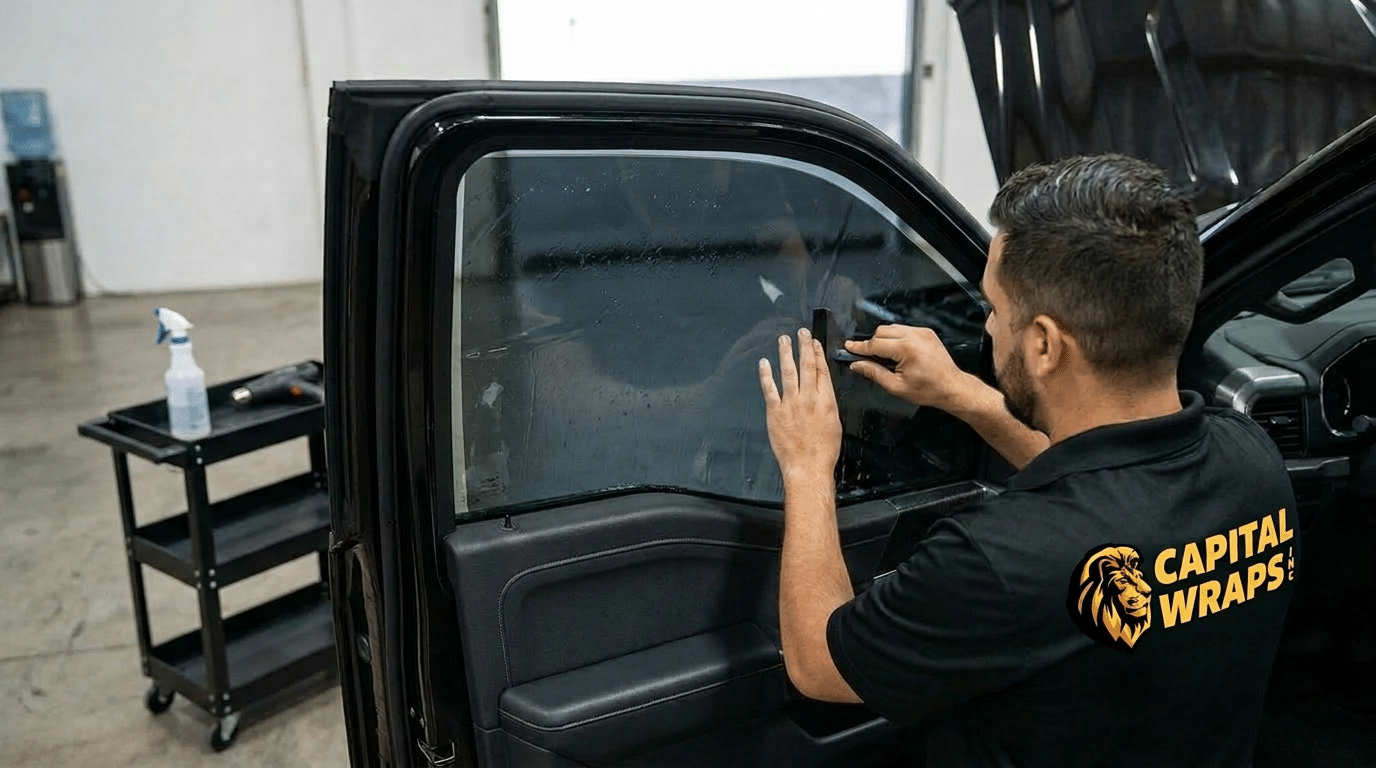
It’s 2:40 on a July afternoon in Raleigh, and a delivery driver is sitting in a wrapped Ford Transit at a red light on Capital Boulevard. The wrap looks sharp — the logo reads clean from fifty feet. But inside the cab, the dashboard thermometer reads 104 degrees. The AC has been running full blast since 8 a.m. By stop number forty, the driver isn’t thinking about efficiency or customer smiles. He’s thinking about the sun coming through the glass – see our fleet tint options.
Here’s what most fleet managers don’t know: federal law limits how dark you can tint a commercial vehicle’s windshield and front windows — light transmission must stay at 70% or higher — but modern ceramic and nano-layer films reject most of the sun’s heat while staying almost completely clear. The darkest tint is not the coolest tint anymore. That changed the math for commercial fleets entirely.
Why 70% Is the Number That Matters
For vehicles regulated under the Federal Motor Carrier Safety Regulations, 49 CFR 393.60(d) is the controlling rule: the windshield and the windows immediately to the driver’s left and right must allow at least 70% of visible light through. Windows behind the driver aren’t restricted by the federal rule.
North Carolina’s statute (G.S. 20-127) sets its own floor of 35% light transmission for most passenger vehicles — and it explicitly defers to the federal standard for commercial vehicles covered by Part 393. That’s why a shade that’s perfectly legal on your personal sedan can put your box truck out of service at a roadside inspection.
The catch: a film’s label rating isn’t the whole story. Tint stacks on top of factory glass, so the combined reading is what an inspector’s meter sees. That’s why we measure every window before recommending a shade — and meter again after installation.
The Fleet Tint Film That Cools Without Darkening
So how does a nearly invisible film beat a dark one? It targets the right part of sunlight. Visible light is only a fraction of solar energy — much of the heat you feel rides in on infrared wavelengths you can’t see.
3M™ Crystalline attacks that invisible heat with more than 200 nano-layers of optical film stacked into a sheet thinner than a Post-it Note. The result: up to 97% infrared rejection and 99.9% UV blockage in shades light enough to satisfy the federal 70% standard. Because it contains no metal, it won’t interfere with GPS, telematics, toll transponders, or the 5G devices your fleet depends on.
SunTek® CXP takes a nano-hybrid carbon approach — a non-reflective, metal-free film that blocks more than 99% of UV rays and carries a manufacturer’s lifetime warranty against fading, bubbling, and turning purple. Its 70 and 80 series shades are built exactly for vehicles that have to stay light and legal.
Both films are signal-safe, both are warrantied for life, and both are installed by our certified team — as we complete our 3M dealer certification for automotive films in North Carolina.
The Wrap Protects Your Brand. The Tint Protects Everything Inside It.
A fleet wrap is a rolling billboard — it works on the people outside the vehicle. Tint works on everything inside it: the driver who stays alert on stop forty, the upholstery and dash that would otherwise crack and fade, the temperature-sensitive cargo, and the AC compressor that no longer runs at maximum all day. Cooler cabs mean less air conditioning, and less air conditioning means measurable fuel savings across a fleet. Wrap and tint aren’t two services. They’re two halves of one finished vehicle.


Frequently Asked Questions
Is ceramic tint better than metallic tint for commercial vehicles? For fleets, yes. Metallic films reflect heat well but can interfere with GPS, cellular, and Bluetooth signals — a real problem for vehicles running telematics. Ceramic and nano-carbon films like 3M Crystalline and SunTek CXP reject comparable or better heat with zero signal interference.
Will light tint actually make a difference in cab temperature? Yes. Heat rejection depends on infrared performance, not darkness. A high-VLT nano-layer film can reject more total solar energy than many dark dyed films, keeping interior surfaces significantly cooler.
Why does cheap tint turn purple? Budget dyed films break down under UV exposure, shifting purple and bubbling as the adhesive fails. Both 3M Crystalline and SunTek CXP are warrantied for life against color change, bubbling, and peeling.
Do the rear windows of my trucks have the same limits? No. The federal 70% rule applies only to the windshield and the two front windows. Windows behind the driver on a commercial vehicle can typically run darker film for privacy and cargo protection — we’ll confirm what applies to your specific vehicles.
The Bottom Line
Commercial vehicles can’t wear dark glass up front — federal rules require the windshield and front windows to pass at least 70% of visible light on fleet tint. Films like 3M Crystalline and SunTek CXP make that limit irrelevant, rejecting the sun’s infrared heat and 99%+ of its UV through nearly clear film. Pair that with your fleet wrap, and the vehicle finally works as hard on the inside as it does on the outside.