
The short answer: 3M DI-NOC walnut Architectural Graphics Film turned 950 square feet of new construction walls into the defining design feature of Dose Yoga’s Durham studio — and it’s built to hold up in one of the most demanding environments a surface film will ever face.
The Project: Dose Yoga Durham
Dose Yoga is a hot yoga studio and café with locations across Raleigh and Durham, NC. Their brand is built around the idea that balance is serious business — high-heat yoga classes, contrast therapy, sauna, hot tub, and cold plunge recovery. When they opened their Durham location, they wanted the space to feel intentional from the moment someone walked in.
That’s where we came in.
What We Did
Dose Yoga’s Durham studio is a new construction buildout. The challenge was making the walls feel finished, warm, and on-brand without the cost or timeline of traditional millwork or tile work.
The scope:
- 950 square feet of 3M DI-NOC walnut architectural film
- Main hallway: 50 feet long by 12 feet tall
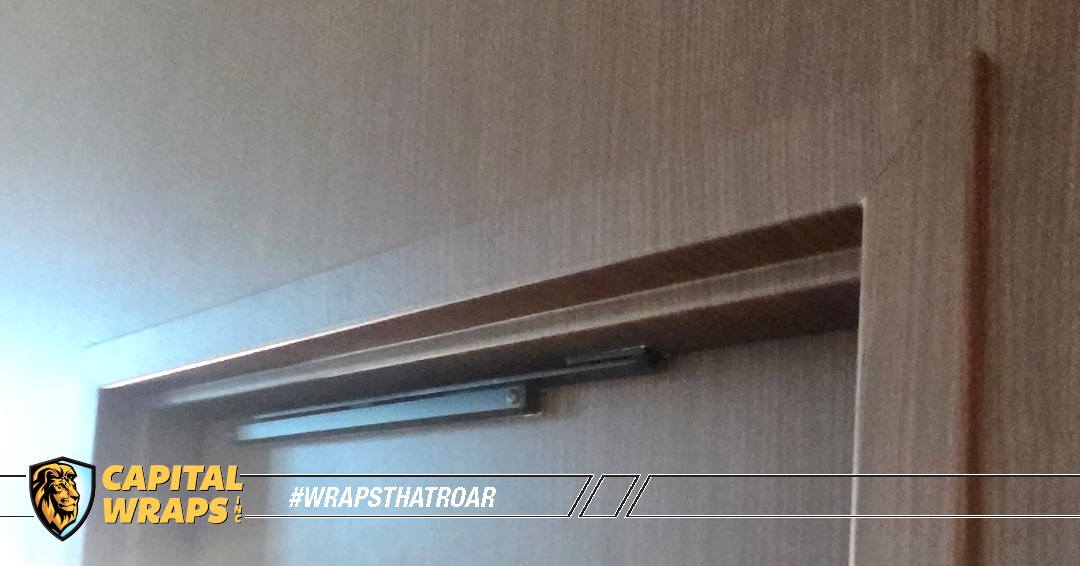
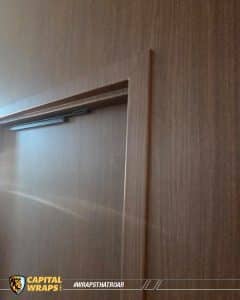
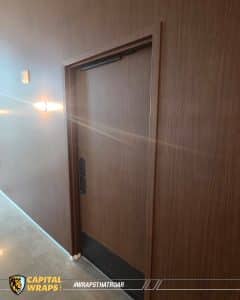
- 2 full doors wrapped — including door jambs and trim — to read as one continuous surface
- Multiple sconces integrated cleanly into the installation
- Back recovery area: sauna alcove and feature wall
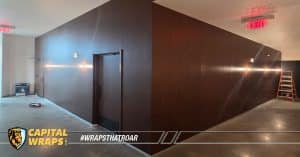
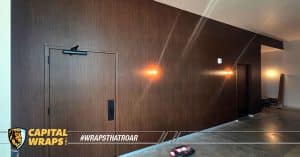
Every detail mattered. Wrapping the doors and trim rather than leaving them as interruptions in the wall surface is the difference between a material that looks applied and one that looks designed.
Why DI-NOC — and Why It Works Here
3M DI-NOC is an architectural film engineered for commercial interior surfaces. It’s not decorative vinyl. It’s a pressure-sensitive film system designed to bond to substrates including drywall, concrete, metal, glass, and wood — and to hold in environments that would degrade most surface materials.
For a hot yoga studio, that matters a great deal.
The back recovery area at Dose Durham contains a sauna, hot tub, and cold plunge tub. That means the film is exposed to:
- Sustained heat and steam
- Dramatic temperature cycling between hot and cold zones
- Humidity levels that challenge adhesives and substrates alike
DI-NOC is rated for high-humidity and elevated-temperature environments when installed correctly. The key phrase is when installed correctly — surface prep, seam placement, and edge finishing determine whether the film performs at year five the way it did on day one.
Installation: What Preparation Actually Looks Like
Architectural film installation is not the same skill set as vehicle wrapping or window graphics. Walls introduce their own variables: surface texture, paint type, joint compound, primer adhesion, and the condition of corners and transitions.
Our process for the Dose Durham install:
- Surface assessment — New construction drywall was inspected for surface contamination, texture consistency, and paint cure. DI-NOC requires a smooth, clean, fully cured substrate.
- Edge and corner planning — The hallway required careful seam mapping to minimize visible transitions across 50 linear feet. The doors and trim required precise cuts to wrap continuously without lifting at edges.
- Sconce integration — Multiple wall sconces required the film to be cut and relieved around each fixture without creating visible gaps or lifting points.
- Back area and feature wall — The recovery zone required specific attention to humidity exposure. Film edges were finished to prevent moisture infiltration at seams.
The result is a surface that reads as architectural rather than applied.
Longevity in Retail and Commercial Spaces
3M rates DI-NOC for a service life of 7 to 12 years in interior commercial applications under normal conditions. In properly prepared and climate-controlled environments, installations regularly exceed that range.
For a yoga studio, the relevant variables are humidity management and surface prep quality — both of which were addressed in this installation. The walnut finish at Dose Durham is not a short-term design choice. It’s a durable surface investment that will outlast multiple rounds of branding updates.
The Result
The main hallway at Dose Yoga Durham is now a defining feature of the space. Warm walnut tones of the Architectural Graphics across 50 feet of wall height, doors and trim fully integrated, sconces sitting cleanly in the surface. The back recovery area carries the same material continuity into a functionally demanding zone.
New clients walking in for the first time experience a space that feels considered — not like a fresh buildout, but like a studio that knew what it wanted to be.
That’s what good architectural film installation does. It makes the space feel inevitable.
Capital Wraps installs 3M DI-NOC and architectural films for commercial interiors, retail buildouts, and hospitality spaces across the Mid-Atlantic and Southeast. Contact us to discuss your next project.