Written by Capital Wraps · Est. reading time: 7 minutes
The short answer: for a contoured commercial vehicle, the right material is cast film. The proven industry workhorse for fleet graphics is standard cast PVC — ORAJET 3951 paired with ORAGUARD 290 — typically warranted around five years and installed on millions of vehicles. The premium option is non-PVC cast polyurethane — ORAJET 3971RA + ProSlide with ORAGUARD 279 — which promises paint-protection-film toughness and longer warranties, but is newer, costs more, and in the field has shown failure modes a fleet manager should understand before committing an entire fleet to it.
In Part 1, we covered why calendered vinyl — standard or premium — is the wrong tool for a contoured vehicle, and how the “memory” baked into calendered film is what makes letters peel and edges lift. Now for the films that were actually built for the job: the two cast tiers.
Tier C: Standard Cast PVC — The Industry Standard
This is the workhorse. It is what the overwhelming majority of professional commercial wraps are built on, and almost every major manufacturer makes their own version.
What makes cast PVC the default isn’t one feature — it’s the menu of engineering options it gives a professional installer:
- Adhesive primers for clean, low-residue removal at end of life
- Air-egress liners (such as RapidAir®) that let trapped air escape for a bubble-free install
- Slide-and-reposition technology (such as ProSlide®) so the film can be placed precisely before it grabs
- Variable initial tack — from a very light “slide it into place” grab to a more aggressive instant bond
Measured against our five tests, cast PVC is where the numbers turn good. Conformability: excellent — it lays into rivets and recesses without a fight. Longevity: most manufacturers warrant around five years in “Zone 2,” which covers most of the U.S. excluding the high-UV desert Southwest and similar climates. Color fastness: strong, especially once a matched cast laminate protects the ink from UV. Failure points: few, when the film and laminate are a matched system.
ORAFOL’s version of this tier is ORAJET 3951 with ORAGUARD 290 — both cast construction, gloss-matched, tested together, and qualifying for the ORAFOL ORALIFE™ Component System Warranty when installed as a complete system. It is the material we specify for the bulk of demanding commercial fleet work, and it is proven across millions of vehicles on the road.
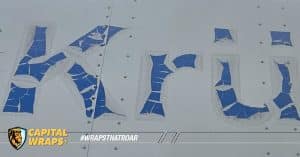
Tier D: Premium Non-PVC Polyurethane — Promising, but Prove It on a Fleet First
This is the newest and most premium tier — a non-PVC cast polyurethane film. ORAFOL’s offering is ORAJET 3971RA + ProSlide with ORAGUARD 279 laminate, and it was the industry’s first cast PVC-free wrapping film.
The pitch is compelling. This material is essentially paint protection film, only thinner: self-healing against minor scratches, superior abrasion resistance, resistant to yellowing and cracking, and durable in extreme tropical, arid, and cold environments. Because it performs more like PPF, some manufacturers extend a longer warranty when you use the full polyurethane system — or even when you use their PU laminate over their cast PVC film. A small number of makers now offer a matte finish in the polyurethane laminate, which is rare in this category.
So why don’t we simply default every fleet to it? Because it is new, and “new” on a fleet is a risk you carry, not the manufacturer.
In real-world installs, the polyurethane films have shown they can be finicky — fussier initial tack and lifting in tight body-line crevices have been reported by shops across the industry. And we have seen something else worth flagging: on some polyurethane offerings, mold or algae — or at least a dark discoloration — can develop between the laminate and the print. On a single show car, that’s a one-off. On a fleet of twenty vans seen by tens of thousands of people a day, that’s a brand problem multiplied by twenty.
None of this means the polyurethane tier is bad. It means it is young, and a responsible wrap partner specs it deliberately — on the right vehicle, for the right client, with eyes open — rather than rolling an entire fleet onto an unproven system because the brochure is exciting.
What a Fleet Graphics Failure Actually Costs
Here’s the part most shops won’t put in writing.
When a wrap fails, the obvious cost is the vinyl. Replace a panel, reprint a section, schedule the install. But the vinyl is the cheapest thing in the equation.
The first hidden cost is downtime. A vehicle in the shop for repair panels or a full re-wrap is a vehicle not generating revenue. Multiply that across a fleet and the math gets serious quickly.
The second hidden cost is the re-wrap itself — you pay for the job twice, because the first material couldn’t go the distance.
But the third cost is the one that never shows up on an invoice, and it’s the largest. A vehicle wrap is your brand traveling at 65 miles an hour in front of 30,000 to 70,000 people a day. When that wrap is peeling, faded, or growing a dark bloom under the laminate, the medium becomes the message. A prospect who sees a curling, discolored truck draws a quiet conclusion: if they can’t keep their own vehicle looking finished, what will they do with my home, my building, my account?
Remember the service company from Part 1 — the one with three letters peeled off the back of the van? They didn’t just pay to fix the lettering. For eighteen months, they drove past thousands of potential customers a day looking like a company that doesn’t finish what it starts. There’s no line item for the calls that never came. But it was, by far, the most expensive part of choosing the wrong vinyl.
Why This Is a Business Decision, Not a Line Item
Choosing wrap material isn’t a technical footnote — it’s a decision about how your brand shows up in your community for the next five years.
That’s exactly why material specification is the conversation we lead with. Over more than 22 years, we’ve beta-tested these films for the manufacturers themselves and shown their products at trade shows and trainings. We run over $2,000,000 in in-house printing equipment and field seven certified installers with 5–25 years of experience each. We don’t guess how a material ages on a real fleet — we’ve watched it happen, and we spec accordingly.
Summary
For a contoured commercial vehicle, cast film is the answer. Standard cast PVC — ORAJET 3951 with ORAGUARD 290 — is the proven, roughly five-year, industry-standard choice for the bulk of fleet work. Premium non-PVC polyurethane — ORAJET 3971RA + ProSlide with ORAGUARD 279 — offers paint-protection-film toughness and longer warranties, but it’s a newer material with real-world quirks (finicky tack, edge lifting, and on some offerings a discoloration or mold bloom under the laminate), so it should be specified deliberately rather than rolled across a whole fleet on faith. And the reason any of this matters: a wrap failure costs far more than vinyl. It costs downtime, a second install, and — most expensively — a brand that looks unfinished to every customer it drives past. Ask your wrap provider which film system they specify and why. The answer tells you how they think about their work, and yours.
Capital Wraps specifies cast film systems matched to the vehicle, the climate zone, and the brand. Contact us to discuss material specifications and warranty coverage for your next fleet project.
Frequently Asked Questions
Q: What is the best vinyl for a commercial vehicle wrap?
A: For contoured vehicles, cast film is best. The proven industry standard is cast PVC such as ORAJET 3951 with ORAGUARD 290 laminate, typically warranted around five years in most of the U.S. A premium non-PVC cast polyurethane option (ORAJET 3971RA + ProSlide with ORAGUARD 279) offers added toughness and longer warranties but is newer and should be specified case by case.
Q: How long does a cast vinyl wrap last?
A: A printed and laminated cast PVC wrap typically delivers about five years of warranted service life in standard climate zones — and often 6–8 years of real-world service depending on sun exposure, washing, and care. Premium polyurethane systems can carry longer warranties.
Q: What is the difference between cast PVC and non-PVC polyurethane wrap film?
A: Cast PVC (e.g., ORAJET 3951) is the proven industry-standard wrap film with a wide range of adhesive and installation options. Non-PVC cast polyurethane (e.g., ORAJET 3971RA + ProSlide) behaves more like thin paint protection film — self-healing and highly durable — but is newer to market, costs more, and has shown some field quirks such as fussier tack, edge lifting, and discoloration under the laminate on certain offerings.
Q: What does it cost a business when fleet graphics fails?
A: Far more than the vinyl. A failed wrap means vehicle downtime, the cost of a second installation, and — most significantly — brand damage, because a peeling or discolored wrap signals to every prospect who sees it that the company doesn’t finish its work. Specifying the correct cast film system up front is far cheaper than any of those costs.
Q: Is non-PVC polyurethane wrap film worth it for Fleet Graphics?
A: It can be, on the right vehicles and for the right client, thanks to its durability and self-healing properties. But because it is a newer material with reported installation quirks and occasional discoloration issues, it should be specified deliberately rather than applied across an entire fleet without testing. A qualified wrap partner can advise where it makes sense.
Wraps that Roar. Award-Winning Wraps Nationwide. View Gallery »