
Written by Capital Wraps · Est. reading time: 6 minutes
The short answer: the single biggest predictor of whether your vehicle wrap still looks sharp in year three — or is peeling, shrinking, and quietly embarrassing your brand — is not the design and not the printer. It is whether the installer used cast or calendered vinyl, and whether the film and laminate were engineered to work together as a system. Cast film conforms, lasts, and removes cleanly. Calendered film, with very few exceptions, does not belong on a contoured vehicle.
A Story About Three Letters
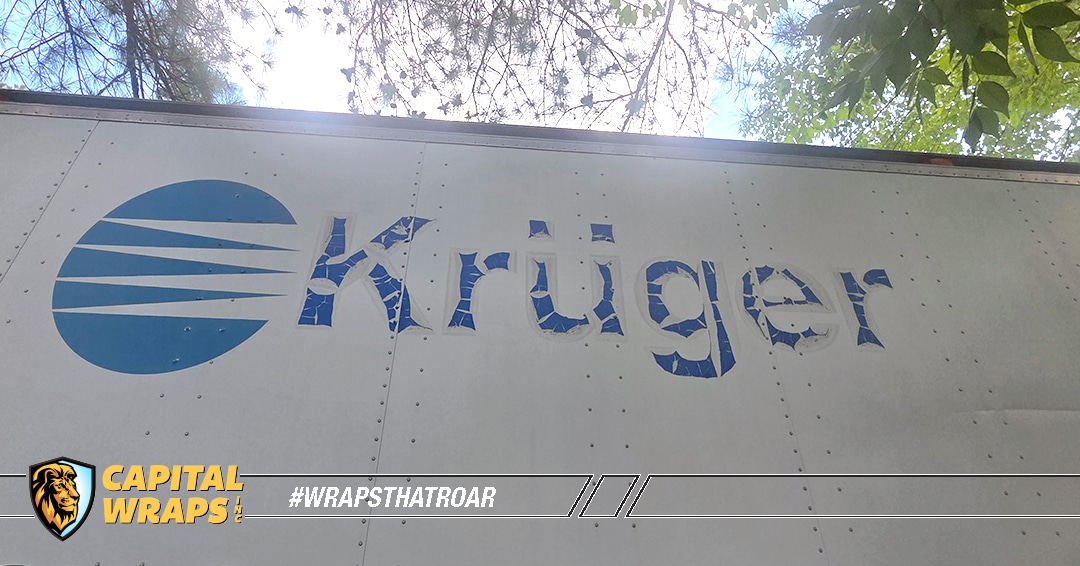
A few years ago a service company called us, frustrated. Their van had been wrapped eighteen months earlier by another shop. The design was fine. The print looked good in photos. But the lettering along the rear quarter panel had started to curl at the corners — the way an old bumper sticker lifts in a July parking lot.
By the time they reached us, three letters of the company name had peeled away entirely. From across a parking lot, a $40,000 plumbing company looked like it couldn’t be bothered to fix a sticker.
Here is the part that matters: that failure was decided long before anyone picked up a squeegee. It was decided the moment someone pulled a particular roll of vinyl off the shelf.
The One Question Almost Nobody Asks About Fleet Graphics
When a client calls about a wrap, they ask about three things: What will it look like? How fast can you do it? What does it cost?
The one thing they almost never ask about is the one thing that governs all three over the life of the wrap — the film specification itself.
It should be the first question.

What “Cast” and “Calendared” Actually Mean
The two families of vinyl are not different grades of the same thing. They are made in fundamentally different ways, and that manufacturing difference is the whole story.
Calendared vinyl is made the way you’d roll out pizza dough — a thick mass of PVC is squeezed between heated rollers and stretched thinner and thinner. Because it was forced into shape under tension, the film remembers that it wants to be flat. Heat it, stretch it, and it fights to shrink back. Orafol 3951 and 270 are great combinations.
Cast vinyl is made the way you’d pour a cake — liquid PVC (or polyurethane) is cast onto a casting sheet and cured in its final form. It was never stretched into shape, so it has no memory and no internal tension. It lies down where you put it and stays there.
That single difference — memory versus no memory — explains almost everything that follows.
Five Ways to Judge a Wrap Film
Before we get to the four tiers of material, here are the five things that actually separate a good wrap film from a bad one. We’ll come back to these throughout both parts of this series.
- Conformability — Will it stretch into rivets, recesses, door handles, and compound curves without fighting back?
- Longevity — How many years until the color, the adhesive, and the surface give out?
- Warranty — What does the manufacturer actually stand behind, and in what climate zone?
- Color fastness — Will the print hold its color, or fade and shift as the plasticizer migrates and UV does its work?
- Failure points — When it does fail, how does it fail — edges, seams, shrinkage, cracking, delamination?
Tier A: Standard Calendared Vinyl (Wrong for Wraps, Full Stop)
This is the cheapest material on the shelf, and on a vehicle it is a near-guaranteed callback.
- Conformability: Almost none. It will not lay into a body line without lifting.
- Longevity: Often measured in months on an exterior vehicle.
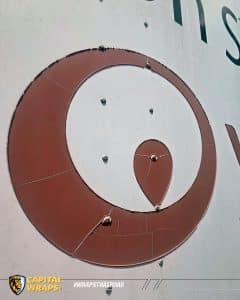
- Failure points: It shrinks. It cracks. It delaminates. And because it remembers wanting to be flat, the edges and individual letters peel away first — exactly like the three letters on that service van.
🖼 IMAGE: Close-up of standard calendared lettering peeling and curling off a vehicle panel — Capital Wraps field photo
There is no version of “we’ll just use the budget vinyl” that ends well on a contoured vehicle. The savings on the front end are erased the first time a panel has to be redone — and that’s before you count what it cost the brand to drive around looking unfinished.
Tier B: Premium Calendared Vinyl (Right Tool, Wrong Job)
This is the more sophisticated cousin — a polymeric calendared vinyl, engineered with more stable plasticizers so it holds up better and longer than the standard product.
But notice what it was designed for: flat surfaces and shorter-term graphics. Think flat-sided box trucks, trailer panels, and short-run promotional graphics — not the compound curves of a cargo van or a pickup.
Some manufacturers will even stand behind it with a short-term warranty — often in the neighborhood of 12 months on specific, flat-paneled vehicles like box trucks. That’s an honest warranty for an honest use case. The trouble starts when premium calendared is sold as a full-vehicle wrap material on a fleet of contoured vehicles. It isn’t one. It’s a flat-surface, short-term material doing a job it was never built for.
So What Is the Right Material?
If standard calendared fails and premium calendared is built for flat, short-term work, that leaves the films actually engineered for vehicle wrapping: cast films.
There are two cast tiers worth knowing — the industry-standard cast PVC that has wrapped millions of vehicles, and a newer non-PVC cast polyurethane that promises paint-protection-film toughness but comes with real-world caveats a fleet manager should understand before committing.
That’s where Part 2 picks up — including the part most shops won’t tell you: what a wrap failure actually costs your brand, long after the vinyl is paid for.
Summary
Vehicle wraps don’t fail because of bad design. They fail because of the wrong film. Calendared vinyl — both standard and premium — is built for flat surfaces and short-term graphics, not the compound curves of a real vehicle. Standard calendared shrinks, cracks, and peels within months; premium polymeric calendared performs well in its lane, but that lane is flat panels and short campaigns. If a wrap provider can’t tell you whether they’re putting cast or calendared film on your fleet — and why — that answer tells you everything you need to know about the wrap you’re about to buy.
Capital Wraps has specified, printed, and installed vehicle graphics for more than 22 years. We beta-test materials for manufacturers, run over $2,000,000 in in-house printing equipment, and field a team of seven certified installers with 5–25 years of experience each. Contact us to talk through the right material specification for your fleet.
Frequently Asked Questions
Q: What is the difference between cast and calendared vinyl?
A: The difference is how each film is manufactured. Calendared vinyl is squeezed and stretched between heated rollers, so it retains “memory” and wants to shrink back to flat. Cast vinyl is poured as a liquid and cured in its final shape, so it has no memory or internal tension. Cast film conforms to curves and lasts far longer on a vehicle; calendared film is better suited to flat surfaces and short-term graphics.
Q: Can I use calendared vinyl for a full vehicle wrap?
A: It is not recommended for contoured vehicles. Standard calendared vinyl shrinks, cracks, and peels at edges and seams within months. Premium polymeric calendared vinyl performs well on flat surfaces and short-term graphics — such as flat-sided box trucks — but is not engineered for the compound curves of vans, cars, and pickups.
Q: Why does my wrap have peeling letters and lifting edges?
A: The most common cause is calendared vinyl used on a contoured surface. Because calendared film “remembers” being flat, its edges and individual cut letters lift and curl first, especially on curves and body lines. Cast film, paired with a matched cast laminate, dramatically reduces this failure mode.
Q: How long does a calendared vinyl wrap last?
A: Standard calendared vinyl on an exterior vehicle often lasts only months before visible failure. Premium polymeric calendared vinyl lasts longer and is sometimes warranted around 12 months on specific flat-paneled vehicles, but it is a short-term, flat-surface material — not a long-term full-wrap film.
Wraps that Roar. Award-Winning Wraps Nationwide. View Gallery »